
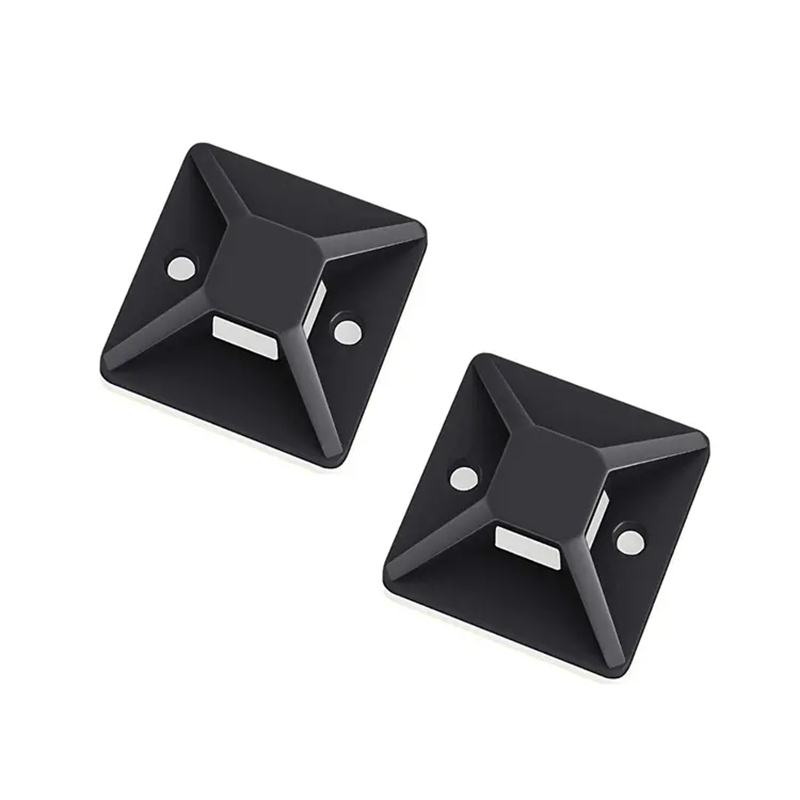
Cable tie mounts are small anchor points that give cable ties a fixed grip, turning loose wires into a routed installation. They stick or screw onto surfaces inside control panels, along chassis rails, under desks, or on server racks and provide slots for a tie to pass through. Once tightened around a bundle, the mount holds it in position. Without cable tie mounts, zip ties slide along beams, twist out of alignment, or wrap around structural members with no control over wire placement.
The Difference a Fixed Anchor Point Makes
A cable tie bundles wires. A cable tie mount fixes that bundle to a surface. That difference matters when routing must stay put. In a moving vehicle, unanchored bundles chafe and wear through insulation. Inside an enclosure, loose cables drift into zones meant to stay clear for airflow or safety. A mount solves both by creating a fixed point that doesn’t shift under vibration, expansion, or maintenance nudges.
The design is simple: a flat base with slots sized for standard cable tie widths. The tie passes through, wraps the bundle, and tightens. Tension pulls the mount toward the bundle, but the adhesive or fastener holds the base firm. The result is wiring that stays where it was meant to go.
Adhesive Backing, Screw Fixing, or Both
Cable tie mounts generally come in three fixing styles, and choosing the wrong one for the surface guarantees a callback.
Adhesive-backed mounts use acrylic or rubber-based adhesive with a release liner. On clean, smooth, non-porous surfaces powder-coated steel or aluminum, glass, rigid plastics they hold for years indoors. Surface preparation is what makes them work: wipe with isopropyl alcohol, let dry, press firmly, and let the adhesive build strength before loading. Adhesive mounts avoid drilling, which matters in sealed enclosures and food-grade areas where holes trap debris.
Screw-fixed mounts have a countersunk or flat hole for a screw or rivet. They are the choice outdoors, in engine compartments, boat bilges, and anywhere temperature swings, moisture, or solvents would eventually lift an adhesive pad. The mechanical fastener removes the adhesive variable entirely. The trade-off is drilling a hole and losing the smooth interior surface at that point.
Combination mounts offer both: an adhesive base for positioning and a screw hole for permanent retention. Peel the liner, stick the mount, then drive the screw. This style suits vertical or overhead surfaces where holding a mount and reaching for a screwdriver otherwise takes three hands.
Where Cable Tie Mounts Do Their Job Day After Day
Once installed, cable tie mounts fade into the background until one fails and a bundle hangs loose. Their presence shows up across a wide range of industries:
- Control panels and switchgear: Rows of mounts guide sensor cables, relay wires, and communication lines along the back panel, creating predictable lanes that separate low-voltage signals from power conductors and leave room for future additions.
- Automotive harness routing: Under the hood, along frame rails, and through door conduits, a mix of adhesive and screw-fixed mounts keeps wiring away from moving parts, hot surfaces, and sharp edges. A mount that fails on a rough road leaves an unprotected bundle rubbing against a bracket.
- Server racks and data centers: Cable tie mounts on vertical rails and horizontal cable managers create tie-down points that keep patch cords organized, avoiding the spaghetti tangle that blocks airflow and complicates troubleshooting.
- Marine and outdoor electrical systems : On boats, dockside panels, and outdoor telecom enclosures, UV-stabilized nylon mounts with stainless steel screw fixation handle salt spray, rain, and sun exposure that would destroy an indoor-rated adhesive in one season.
- Furniture and office cable organization : Under-desk mounts keep power bars, monitor cables, and network drops off the floor. The mounts are small enough to stay out of knee space but strong enough to hold the weight of a bundled power cord without peeling away.
- Signage and lighting installations: LED strip wiring, transformer cables, and sensor leads on illuminated signage stay in position when mounts provide tie-downs along the back of the sign frame.
Across all these settings, the common requirement is a fixed routing point that holds position for the life of the installation. A mount that fails creates a wandering bundle, and a wandering bundle finds a sharp edge, a hot pipe, or a pinch point sooner or later.
Choosing the Right Size and Material
Cable tie mounts are not one-size-fits-all. A few practical checks sort the options:
- Tie width compatibility: The mount slot accepts a specific maximum tie width. A mount for 4.8 mm ties won’t fit a 7.9 mm heavy-duty tie. Matching them prevents jamming or pull-through under load.
- Base dimensions: A larger base spreads adhesive load over more surface area and resists peel better than a small pad. For heavier or vibrating bundles, a broader footprint reduces stress at the adhesive edge.
- Material grade: Nylon 6/6 is standard indoors. UV-stabilized nylon resists sunlight embrittlement outdoors. Heat-stabilized grades prevent softening and creep near heat sources inside enclosures. In food processing, metal-detectable materials ensure any stray mount gets caught by inspection equipment.
Installation Habits That Prevent Mount Failure
Most cable tie mount failures come from rushed surface prep or poor tensioning, not defective product. The adhesive needs a clean, dry, oil-free surface. A quick wipe with isopropyl alcohol removes cutting oil, fingerprints, and dust that block bonding. Adhesive strength builds over time loading the mount immediately reduces the final hold.
When tightening, cinch firmly enough to stop movement but don’t crush the bundle into the wire insulation. Overtightening pulls the mount away from the surface and increases the risk of adhesive peel or screw pull-out with no routing benefit.
For screw-fixed mounts, match the pilot hole to the screw core diameter, not the thread outer diameter. Too large and thread engagement drops to near zero. Too small and the mount base can crack, especially with nylon in cold conditions where ductility fades.
Maintenance That Catches Problems Early
Installed cable tie mounts need little maintenance but should be part of routine visual checks. A mount lifting at one edge of the adhesive pad is still holding but losing surface area. Catching it early lets maintenance replace it without repositioning the entire bundle. A cracked base around the screw hole usually points to overtightening or thermal expansion mismatch. Replace the mount and add a washer under the screw head to spread the load.
Outdoor mounts exposed to UV should be checked every few years for chalking and brittleness. A nylon mount that has lost flexibility and snaps when pressed is near the end of its life the bundle it supports is one snag away from coming loose.
A Small Part That Keeps Wiring Installations Professional
Cable tie mounts are easy to overlook until they are missing. Drooping wires, shifting bundles, and messy routing all point to a lack of fixed anchor points. The mounts cost little. What they deliver is faster troubleshooting, less chafing damage to cable jackets, and a cleaner installation. Placing them before pulling the first wire turns a messy job into an organized result that lasts the life of the equipment.
Post time: May-07-2026